


Introduction: The Tripod Leg Question That Reveals Its Core Value
You’ve probably wondered, “How many legs does a tripod have?” at some point—even if you’ve used one before. The answer is simple: three. But this seemingly basic detail isn’t just a fun fact—it’s the foundation of why tripods are essential for sharp, professional shots. As you pursue better photography or videography, understanding the logic behind the 3-leg design will help you choose the right tool—and Telesin tripods are engineered to maximize this design’s advantages for your real-world shooting needs.
The Science Behind Why Tripods Have 3 Legs (And Why It Matters for You)

The 3-leg design isn’t arbitrary—it’s rooted in basic physics, and it directly impacts the stability and usability of your tripod. For you, this means clearer shots, less frustration, and more creative control.
1. The Perfect Balance: No Wobble, No Compromise
Any three points form a stable, flat surface—something no 4-legged design can guarantee. You’ve likely experienced a wobbly 4-legged chair on an uneven floor; a 3-legged tripod eliminates that problem entirely. This natural balance ensures your camera stays steady, even on imperfect surfaces, so you never miss a sharp shot due to unnecessary movement.
2. Adaptability to Any Terrain
When you’re shooting outdoors—on rocky hills, sandy beaches, or sloped trails—Telesin tripods turn this 3-leg advantage into practical usability. Each leg adjusts independently, letting you level your camera quickly and confidently, even on the most uneven ground. Unlike 4-legged alternatives (quadpods), which wobble on rough terrain, Telesin’s 3-leg design keeps your gear secure, no matter where you shoot.
When You Need a Tripod (And How Telesin Delivers)

A tripod isn’t just “extra gear”—it’s the difference between a blurry snapshot and a polished shot. Here are the key scenarios where you’ll rely on it, and how Telesin tripods are optimized to perform:
- Low-Light Photography: In dim conditions, your camera needs a slow shutter speed to capture light. Even the smallest handshake ruins the shot—but Telesin’s stable 3-leg base holds your camera completely still, delivering crisp night shots, indoor portraits, and cityscape photos.
- Long Exposure Shots: Creative effects like smooth waterfalls, streaking clouds, or light trails require a steady camera. Telesin tripods eliminate motion blur, letting you experiment with slow shutter speeds and unlock artistic possibilities you can’t achieve handheld.
- Sharp Landscapes: For landscape photos where every detail matters—from foreground flowers to distant mountains—you need consistent stability. Telesin’s 3-leg design ensures your camera stays level and steady, so every element stays in focus.
- Close-Up & Product Photography: When shooting small subjects up close, even a tiny shake ruins focus. Telesin tripods lock your camera in place, giving you the precision to nail perfect focus for macro shots, product shots, or detailed close-ups.
Telesin Tripod Leg Design: Beyond Just Three Legs
A tripod’s performance depends on more than just the number of legs—it’s about materials, adjustability, and thoughtful engineering. Telesin tripods combine the 3-leg advantage with high-quality components to meet your unique shooting needs.
Leg Materials: Lightweight, Strong, and Vibration-Resistant
Telesin offers two premium materials, each tailored to different use cases—so you can choose the perfect tripod for your style:
|
Material |
Key Benefits |
Ideal For You |
|
Aluminum |
Affordable, ultra-strong, and durable—built to withstand regular use and minor impacts. |
Studio shooting, roadside photography, or anyone on a budget who doesn’t want to sacrifice strength. |
|
Carbon Fiber |
Lightweight (30% lighter than aluminum), excellent vibration dampening, and resistant to extreme temperatures. |
Travel, hiking, or any scenario where you need to carry your tripod for long distances without added bulk. |
Leg Locks: Fast, Secure, and User-Friendly
Telesin tripods feature two intuitive leg lock designs, so you can set up quickly and focus on your shot:
- Flip Locks: Instantly adjustable—you can see at a glance if they’re locked, making setup fast for time-sensitive shots (like sunsets or moving subjects).
- Twist Locks: Compact, quiet, and snag-free—perfect for travel or shooting in tight spaces where you don’t want gear to get caught on branches or rocks.
Center Column: Extra Height Without Sacrificing Stability
Most Telesin tripods include an adjustable center column for extra height when needed—but unlike generic tripods, Telesin’s design minimizes instability. You can raise the column for overhead shots or tight spaces, but the 3-leg base still maintains core stability. For maximum sharpness, Telesin recommends using the legs to adjust height first (for optimal stability).
Tripod Heads: Control Tailored to Your Shooting Style
The tripod head is your control center—and Telesin offers heads designed for every type of photography, so you can move your camera exactly how you need to:
- Ball Heads: Fast and versatile—one knob lets you move the camera freely, ideal for general photography, travel, and quick composition changes.
- Pan-and-Tilt Heads: Precise control with separate knobs for vertical and horizontal movement—perfect for landscapes, architecture, and static subjects where accuracy matters.
- Fluid Heads: Smooth, professional motion for video—eliminates jerky movements, making it ideal for vlogging, short films, and dynamic video shoots.
- Gimbal Heads: Balances heavy lenses (e.g., telephoto lenses) for smooth tracking—great for wildlife, sports, or any scenario where you need to follow moving subjects.
Tripod vs. Monopod vs. Bipod vs. Quadpod: Why Telesin’s 3-Leg Design Wins for You

You have options when it comes to camera supports—but the 3-leg tripod is the most versatile for most photographers and videographers. Here’s how it stacks up, and why Telesin’s tripod design is the best choice for your needs:
|
Support Type |
Number of Legs |
Best For |
Pros |
Cons |
|
Monopod |
1 |
Sports, events, fast-moving subjects |
Lightweight, easy to move, supports heavy cameras |
Cannot stand alone—requires you to hold it, no full stability |
|
Bipod |
2 |
Rare in photography (more common for rifles) |
Steadier than a monopod |
Cannot stand alone—still requires holding, limited stability |
|
Telesin Tripod |
3 |
Landscapes, video, low-light, close-ups, travel |
Most stable on any terrain, holds camera independently, versatile |
Slightly slower to set up than a monopod (worth it for stability) |
|
Quadpod |
4 |
Industrial gear, large movie cameras |
Supports extremely heavy equipment on flat surfaces |
Heavy, slow to set up, wobbles on uneven ground (impractical for most users) |
For you, the choice is clear: when you need absolute stability, versatility, and control—whether you’re hiking, shooting in a studio, or capturing video—Telesin’s 3-leg tripod is the optimal tool. Quadpods are overkill for everyday use, while monopods and bipods lack the stability you need for sharp, creative shots.
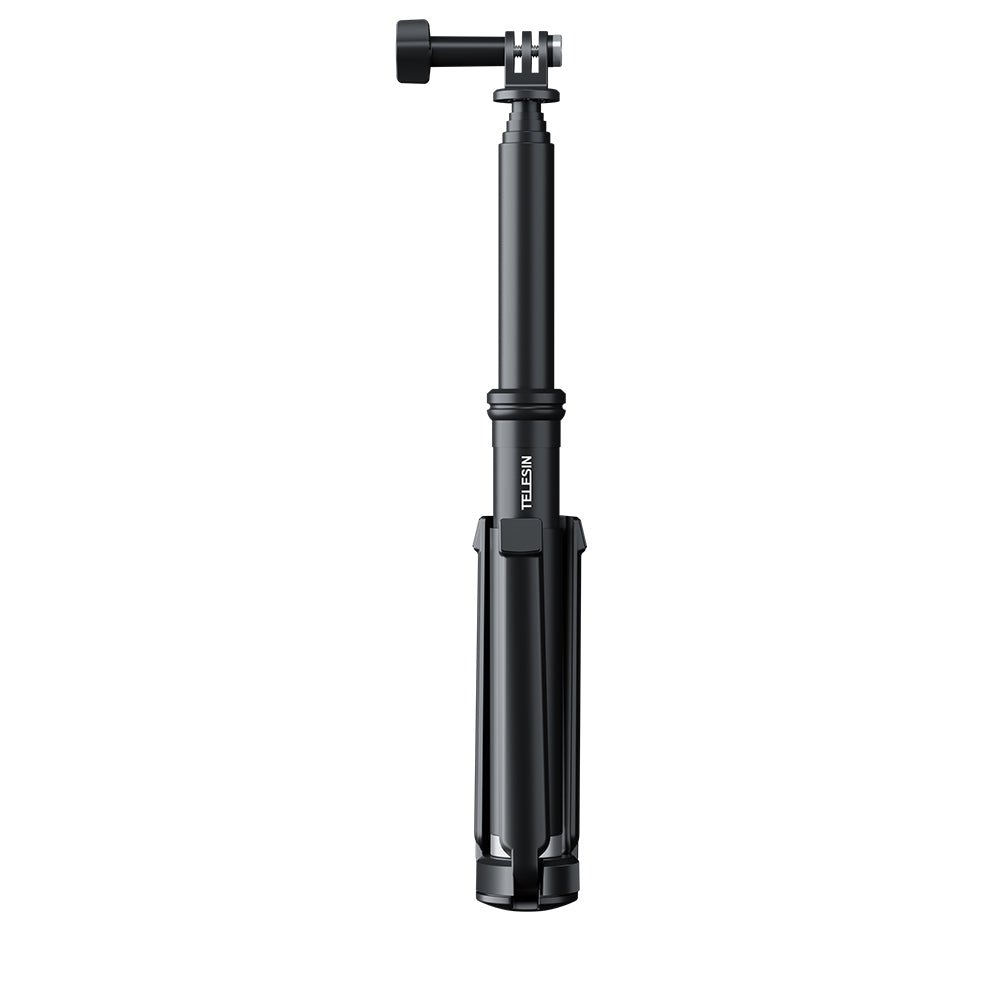
TELESIN 0.9m Extendable Aluminum Alloy Selfie Stick with Tripod and Phone Clip for GoPro
Tripod
$26.24
Buy NowFAQs
Q1: How does a tripod’s weight capacity relate to its stability?
A tripod’s weight capacity is the maximum weight it can safely support. If your camera and lens exceed this capacity, the tripod will be unstable—its legs may bend, or the head may slip. Telesin tripods are engineered with a safety margin: we recommend using gear that weighs 70-80% of the tripod’s capacity for optimal stability, even in windy conditions. This ensures your equipment stays secure, no matter the shot.
Q2: Does Telesin make small tripods for phones and compact cameras?
Yes—Telesin offers mini tripods specifically designed for phones, action cameras, and compact cameras. These portable tripods are lightweight, foldable, and feature adjustable legs that can wrap around railings, tree branches, or other objects for flexible positioning. They’re perfect for vlogging, video calls, group photos, or on-the-go shooting—delivering the same stability as full-size tripods, scaled down for your small devices.
Q3: How do I position a Telesin tripod on a slope or hill?
When setting up on a slope, position one leg uphill and the other two downhill—this creates a wide, stable base. Shorten the uphill leg and lengthen the downhill legs until the tripod’s top is level. Telesin’s independent leg adjustment makes this quick and easy. Always tighten the leg locks fully before attaching your camera to keep the center of gravity low and prevent tipping.
Q4: Do low temperatures affect Telesin tripod performance?
Cold temperatures can impact any tripod, but Telesin’s design mitigates these effects. Aluminum tripods will feel cold to the touch (we recommend gloves for comfort), while carbon-fiber Telesin tripods remain warmer and resist temperature-related brittleness. If you move a cold tripod indoors, condensation may form inside the leg tubes—wipe down the legs and let them dry gradually to prevent freezing or damage.
Final Thoughts: Telesin Tripods—Your Tool for Better Shots
Now you know: a tripod has three legs, and this design is the key to stability, adaptability, and creative control. Telesin tripods take this fundamental design and elevate it—with premium materials, intuitive controls, and versatile features tailored to your shooting needs. Whether you’re a beginner or a pro, a Telesin tripod helps you capture sharper, more artistic shots, no matter where your photography takes you.


